ONLINE TREATMENT FOR ACID REFLUX & GERD
Chat with a medical provider without leaving your home. Manage acid reflux, GERD, and medications for only $49 for your first month.
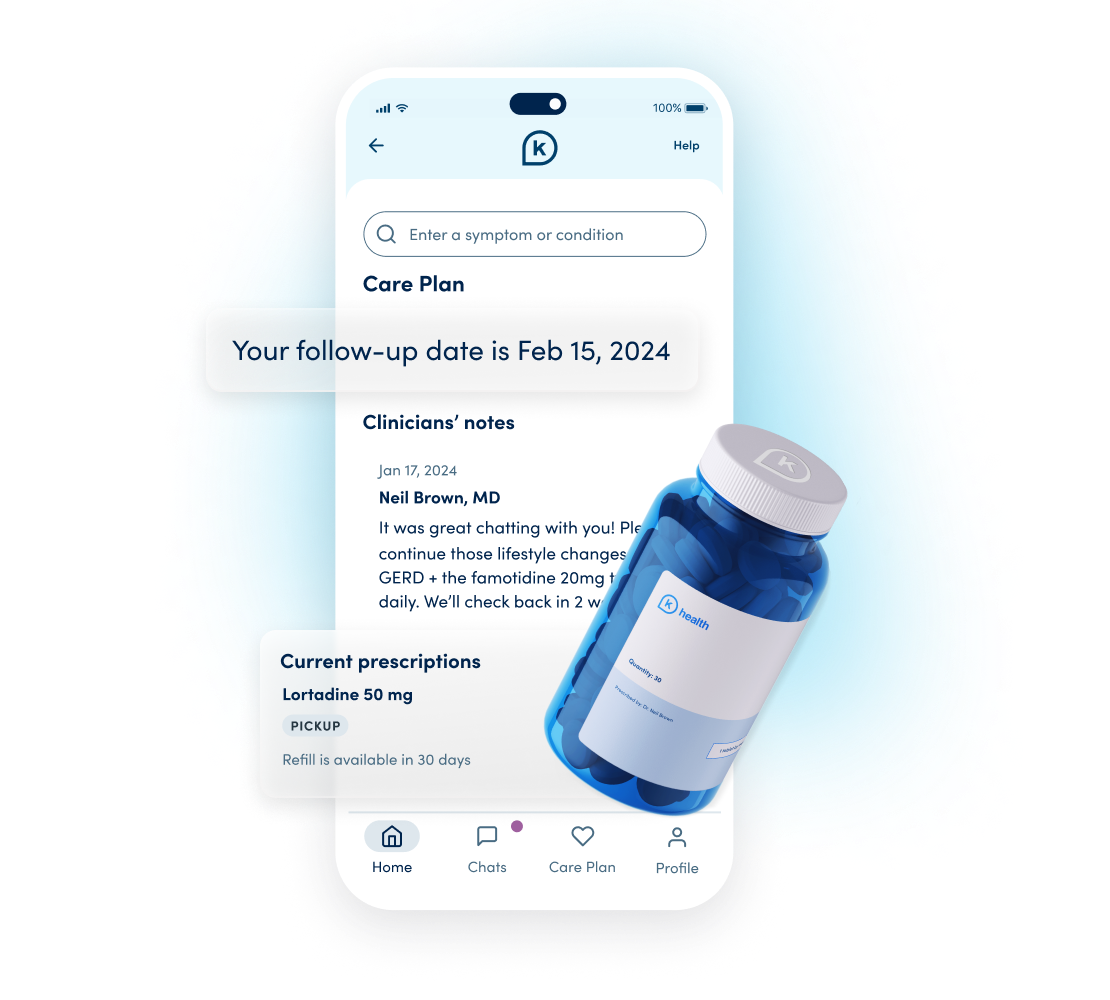
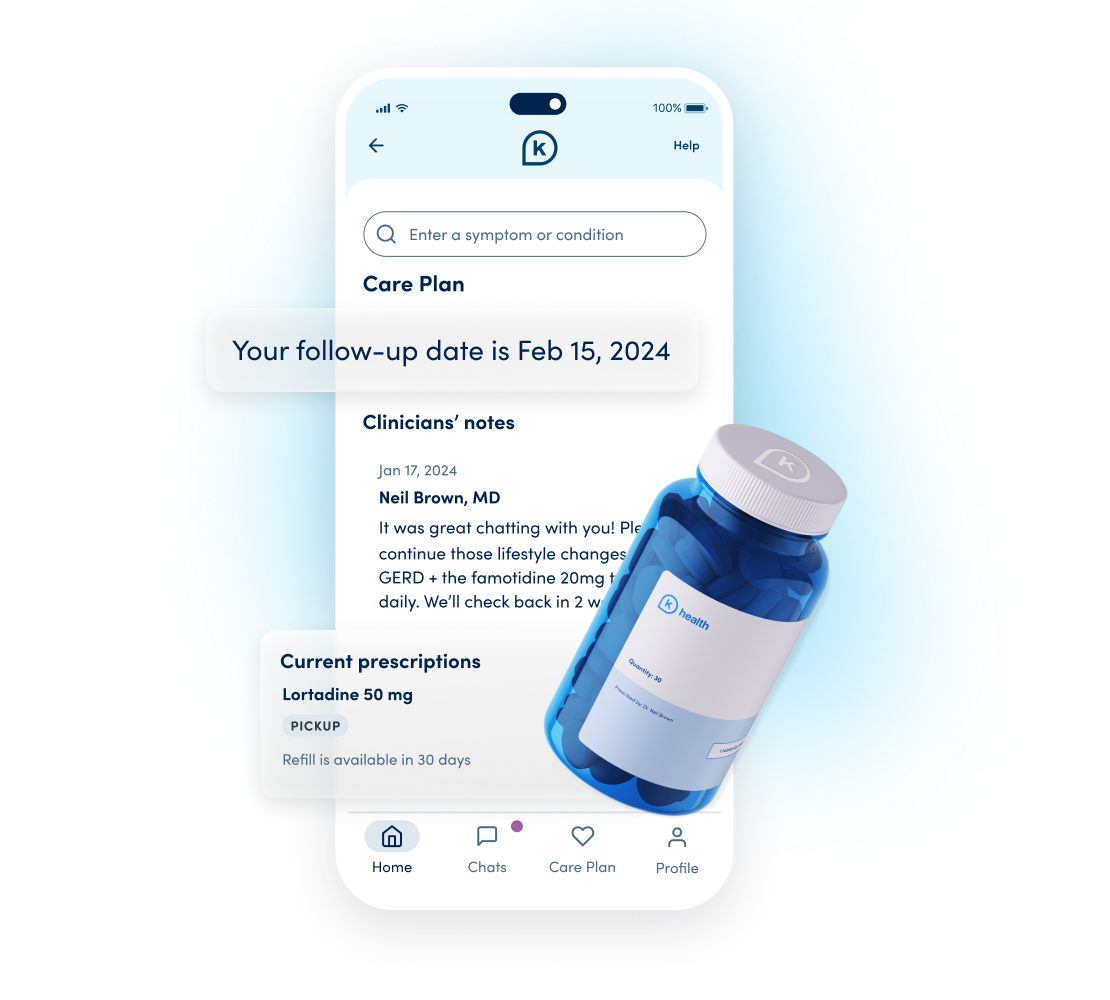
HOW IT WORKS
Acid reflux management made easy—all from your phone

Tell us about yourself
Our smarter, faster, virtual intake process gets your doctors the info they need to care for the whole you.

Get care on your schedule
Text us when you’re free—we make ourselves available day and night. For virtual check-ins, refills, and more.

Manage your health with ease
We’ll help you stick to your plan for managing a chronic disease*, changing a habit, and living healthier—by phone.
The advantages of Primary Care with K Health
See a provider without seeing a provider
Make a flexible appointment with a medical provider right from the app, as often as you want.
Feel good about feeling good
Manage chronic conditions, mental health, your weight, and more. Plus, generic meds come at a low price.
Get 24/7 Urgent Care, too
A K Health membership also includes unlimited virtual visits for medical issues that pop up suddenly.
Pay just $49 for your first month
After the first month, membership fees are billed in advance 3 months at a time, and you can cancel anytime until 1 day before your renewal date.
LEARN MORE
Can acid reflux be treated online?

Acid reflux is a condition you can receive treatment for online by scheduling a telehealth appointment with a medical provider. During your video consultation, your medical provider will review your health history and current medications and ask you a series of questions about your symptoms. The goal is to determine if your symptoms point to acid reflux as being your problem.
After determining your diagnosis, your medical provider will review the risks and benefits of several treatment plans, including medications and some dietary changes that may reduce your acid reflux symptoms. The treatment plan depends on how severe your case is. If the medical provider feels it necessary, they will advise you to seek in-person medical care for further evaluation.
What is acid reflux?
If you’ve ever felt a painful burning sensation behind your chest bone after eating, an acidic taste in your mouth, persistent coughing, or bad breath, you may have experienced acid reflux.
Acid reflux is when acid from your stomach enters your esophagus, the tube through which food travels from your mouth down to your stomach after you swallow. This occurs when the small muscle at the bottom of your esophagus does not close properly after allowing food to pass through. As a result, the acid in your esophagus causes a burning sensation in your chest and a sour taste in your mouth.
Sometimes acid reflux goes away on its own. However, recurring acid reflux without proper treatment can lead to complications like inflammation of the esophagus, ulcers, and narrowing of the esophagus.
What’s the difference between acid reflux and GERD?
Many people believe acid reflux and gastroesophageal reflux disease (GERD) refer to the same thing; however, they are different.
Acid reflux refers to when stomach acid occasionally leaks into your esophagus after eating certain foods or lying down too soon after eating. Sometimes people also call this indigestion or heartburn.
GERD is a more severe and long-lasting condition when a person experiences acid reflux frequently. Repeatedly having acid in your esophagus can cause several complications, including:
- Ulcers and bleeding in the esophagus
- Narrowing of the esophagus
- Chronic cough
- Hoarse voice
- Laryngitis
- Wearing away tooth enamel
What are the symptoms of acid reflux?
Symptoms of acid reflux may include:
- Burning sensation behind the chest bone
- Taste of stomach acid in the mouth
- Nausea
- Problems swallowing
- Chronic cough
- Hoarse voice
What causes acid reflux?
The muscle at the end of your esophagus and your diaphragm muscle usually work together to prevent stomach acid from leaking into your esophagus. Sometimes, however, your esophageal muscle doesn’t close all the way due to certain factors such as:
- Experiencing overweight or obesity
- Pregnancy
- Smoking or inhalation of secondhand smoke
Several medications also may cause acid reflux or make it worse. Those medications include:
- Calcium channel blockers
- Benzodiazepines
- Certain asthma medications
- Nonsteroidal anti-inflammatory drugs (NSAIDs)
- Tricyclic antidepressants
Having a hiatal hernia also increases your risk for acid reflux. Hiatal hernia is a condition in which a portion of the stomach protrudes up through the diaphragm and into the chest.
How can I get rid of acid reflux?
Several lifestyle changes and medications may help your acid reflux go away.
Lifestyle changes your medical provider may recommend include:
- Maintaining a healthy weight if you are experiencing overweight or obesity
- Stop smoking
- Elevate your head and chest when you sleep
- Do not eat within three hours of lying down
Certain foods and drinks may trigger acid reflux symptoms or make them worse. Try avoiding these foods commonly linked to acid reflux:
- Citrus fruits and tomatoes
- Alcoholic drinks
- Chocolate
- Coffee and other caffeinated drinks
- High-fat foods
- Mint
- Spicy foods
What medications treat acid reflux?
Several medications are available over-the-counter (OTC) or by prescription for treating acid reflux. However, if your symptoms continue to recur, make an appointment to speak with a medical provider.
Antacids help relieve occasional symptoms by neutralizing stomach acid but should not be taken daily. Examples of antacids include:
- Milk of magnesia available OTC
- TUMS available OTC
- Mylanta available OTC
- Gaviscon available OTC
H2 blockers help decrease the amount of acid in your stomach.
- Duo fusion available OTC
- Pepcid (famotidine) available by prescription
Proton pump inhibitors (PPIs) lower the amount of acid your stomach makes. These usually work better than H2 blockers.
- Prilosec (omeprazole) available OTC
- Nexium (esomeprazole) available by prescription
- Protonix (pantoprazole) available by prescription

Your K Health unlimited membership includes:
-
24/7 text-based Urgent Care
-
Flexible appointments for ongoing care
-
Low-cost generic meds delivered to your door

Avoid the stressful search for care
Join primary care